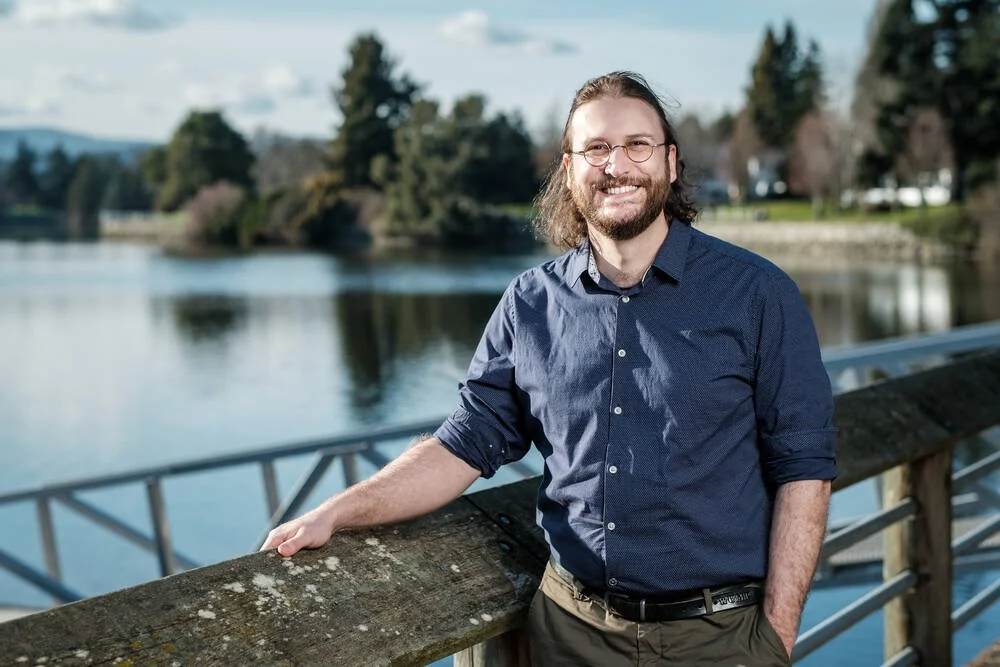
Saanich Incumbent, Teale Phelps Bondaroff
Are you familiar with the lingering issues created by the People, Pets and Parks Strategy in Saanich?
Yes, I am aware of a number of issues associated with the PPP. The first that comes to mind is the vandalism of recently-installed fencing along the Glendenning Trail in PKOLS, and this is troubling. This damage costs the District unnecessarily, while also consuming staff time. Critically, it is important for our staff to have a safe workplace and not be harassed in the course of just doing their job. The fencing is intended to protect a sensitive ecosystem, limit trail widening, and allow the forest floor time to recover without being disturbed. The fence is necessary to allow dogs to be walked off leash while achieving this outcome. One issue associated with this is the need for more ongoing education on the purpose and quality of the fencing, which may help people adjust to the change. I cannot underscore that damage to municipal property is very worrying and is unacceptable. I am also aware that many members of the community would like to see more off leash opportunities around the District and particularly on PKOLS. My hope is that we can complete the implementation of the PPP, evaluate it using good empirical metrics, and then explore further opportunities should they be possible in light of this evidence.
2. Has the People, Pets, and Parks (PPP) initiative been effective so far? Why or why Not?
The People, Pets, and Parks Strategy has many positive results we hope to achieve, including reducing disturbance to birds and wildlife; improving dog waste management; and reducing disturbance to sensitive ecosystems including riparian areas, wetlands, estuaries and mudflats, Coastal Douglas fir and Garry oak ecosystems. The Strategy includes a detailed plan to monitor effectiveness in achieving these goals, which should include: • Number and nature of by-law and etiquette infractions. • Number and severity of safety issues. • Severity of damage or maintenance issues (waste bins, signage, fencing etc.). • Severity of disturbances to natural areas. • Number and nature of disturbances to wildlife. • Extent of uncollected dog waste. • Other observations about park use (crowding etc.). I’m looking forward to seeing how the community will be engaged in these monitoring efforts, possibly with an online tool such as a QR code that will allow park users to report bylaw infractions and issues directly to the District of Saanich or to CRD Animal Care Services. Until this data collection and evaluation work has been done, it is premature to say if the strategy has been effective and whether changes are required. It is important that we complete the plan, gather data across a range of categories, compare this data against baselines, and use this comparison to properly evaluate the effectiveness of the plan. At which point, we will be able to properly determine the effectiveness of the plan to date and have a better understanding of possible areas for improvement/expansion of further off leash opportunities.
3. What aspects of the PPP, if any, do you think need to change? Please see my above answer.
4. How do you see Saanich supporting education programs related to Park, beach and trail etiquette?
Yes, education around trail, park, and beach etiquette is very important. To my understanding, Saanich already does this, as the PPP strategy explicitly calls for education, and flags this as a key component of the plan. We should continue funding and implementing this work. Saanich should continue to support education and outreach about responsible use of parks, beaches and trails, building on the approaches already identified in the People, Pets and Parks Strategy and the work Parks staff are already doing. Education is an important part of helping people understand how to share public spaces respectfully, including expectations around dogs, leash requirements, wildlife and sensitive environments, and consideration for other park users. Clear signage and information at the locations where people are making decisions about how to use a space are particularly important, along with broader communication through Saanich’s website, social media and community outreach. I would support continuing to evaluate which approaches are effective and adapting them as needed. Education should be easy to understand, accessible, and focused on helping people comply with the rules and understand the reasons behind them. The goal should be to make responsible park use the easy and expected choice, while recognizing that education works alongside appropriate infrastructure, clear regulations and reasonable enforcement. This is consistent with the PPP Strategy’s emphasis on education, communication and stewardship as tools for reducing conflict and supporting respectful use of shared public spaces.
5. Is the $1.7M taxpayer funding allocated to the PPP the best use of those funds for Saanich? Why or why not?
I think the more informative question is whether the outcomes the People, Pets, and Parks Strategy is intended to achieve are important and worth investing in. I believe they are. Council directed the creation of the PPP Strategy in 2021 in response to increasing conflict between people and pets, pets, and wildlife, and pets and the environment, as well as the need to better align Saanich’s approach with federal migratory bird regulations. Those challenges haven’t gone away. Saanich is also a growing and changing community. More residents are living in smaller homes and multi-unit buildings, increasing reliance on public parks as places to socialize, exercise, relax, and play. At the same time, park visitation increased significantly during the COVID-19 pandemic. Our parks are being asked to accommodate more people, with a wider range of needs and expectations, in a relatively finite amount of space. The PPP Strategy provides a framework for managing those competing uses, while protecting sensitive environments, improving education and compliance, and providing appropriate opportunities for people with pets. Those are outcomes I think Saanich should continue to value. That does not mean every element of the strategy should be considered permanent or beyond review. As with any significant public investment, we should monitor whether individual measures are achieving their intended outcomes and adjust them when evidence shows that changes are warranted.
6. Are you familiar with the Peg and Post fencing added to PKOLS this year? a. Do you support spending a further $270,000 to fully enclose the 1.7 km off-leash trail at PKOLS? Why or why not?
I am familiar with this fencing, and I support what will give the ecosystem the best possible chance at recovery while retaining off-leash access. Currently I support finishing the remaining fencing work at PKOLS. I am a strong supporter of evidence-based decisionmaking. As such, once installation is complete, we should gather data on effectiveness, evaluate this date, and then explore further steps in light of this data. As I note above, once the project is complete and we have longitudinal metrics, we can then make further choices concerning potential off leash trail expansion, alternative fence designs/materials in light of this data.
7. In seeking to be elected what do you stand for that you think would be important for our members to know about?
I understand how important pets are to people and their families, and the companionship and joy they bring to our lives. Our parks and public spaces should be welcoming places that everyone in our community can enjoy. Sharing these spaces means being considerate of one another and respecting the different needs of those who use them. I have a background in conservation and animal protection. I serve as the Director of Research for OceansAsia, a marine conservation organization that works to tackle marine wildlife crime. I have also worked as a consultant, supporter, and volunteer with a number of conservation and animal-focused organizations, including World Animal Protection, the Sea Shepherd Conservation Society, the Fur-Bearers, BC SPCA, the Black Fish, and the Sea Ranger Service. I understand the importance of protecting ecosystems and ensuring that animal welfare is top of mind. I am always happy to meet with residents to chat about local issues. This term, I held regular weekly office hours (Thursdays in my local coffee shop), and I plan on continuing this practice if re-elected. I had the pleasure of meeting with representatives from CRD DOGGS on a couple of occasions and look forward to future conversations.